
The AI Transition in India’s Tech Sector: Business Models, Job Market Realities, and Macroeconomic Implications
June 9, 2026 · admin · Blog
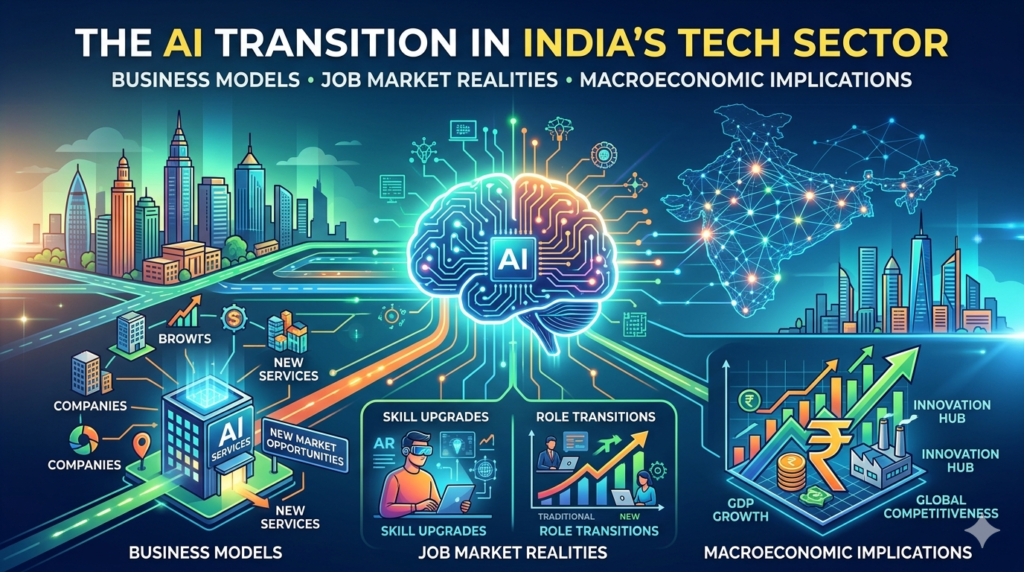
Strategic Insight Brief for HNI Investors
Executive Overview for Asset Allocation
As HNI investors, assessing structural changes in listed IT equities and their broader impact on domestic demand is critical. The ongoing AI shift is causing near-term disruption and employee anxiety, but it represents a structural transformation rather than an industry demise.
While linear headcount-linked models are deflating, high-leverage GCC expansion is surging. Total tech employment is set to rise, mitigating massive systemic threats to discretionary consumption and urban real estate markets. Listed IT services face a temporary ‘J-Curve’ transition before emerging as leaner, highly profitable entities.
Q: How is Artificial Intelligence structurally altering the business model of traditional Indian IT services companies?
Historically, Indian IT services companies operated on a linear asset-heavy business model where revenue was directly tied to headcount (Headcount × Billable Hours × Billing Rate). AI breaks this link entirely. The industry is rapidly adopting internal ‘software factories’ where engineers transition from manual craftspeople typing every line of code to automated pipeline operators managing AI workers.
This structural change triggers an immediate productivity gain but causes temporary revenue deflation for legacy contracts. Simple application maintenance, volume-based code testing, and Level-1 support tasks are seeing automated cost reductions, resulting in localized contract value compressions of 2% to 3% annually as fewer human hours are required for identical deliverables.
Q: What are the realistic timelines for this business model transition, and what does it mean for mid-term financial performance?
The transition follows a classic financial ‘J-Curve’ divided into two distinct macroeconomic phases over the next five years:
• Phase 1 (Years 1–3) – The Transition & Compression
Topline revenue growth for listed IT majors will likely remain muted at a 4% to 6% CAGR. This compression occurs because traditional legacy contracts deflate immediately from automated efficiencies, while corporate discretionary budgets for massive, net-new enterprise AI architectures take longer to scale.
• Phase 2 (Years 3–5) – The High-Velocity Rebound
Topline revenue is projected to accelerate sharply to a 10% to 12%+ CAGR. As global enterprises look to build out proprietary ‘world models’ (3D spatial context for automation) and deploy millions of parallel AI agent populations, the addressable market expands by an incremental $300 Billion to $400 Billion globally.
Indian tech majors, having re-engineered their operational pipelines, will capture high-value architecture, integration, and lifecycle management contracts.
Crucial for Mutual Fund Investors
Bottom-line profitability (EBIT margins) will decouple from revenue during Phase 1. Driven by immediate operational leverage, lower lateral recruitment expenses, and stabilized employee attrition (12%–13%), operating margins will remain structurally resilient at 22%–23% before expanding aggressively in Phase 2 as high-margin consulting replaces commodity code-writing.
Q: Is the fear of widespread engineering retrenchment and a shrinking overall IT sector job market justified?
The fear of a permanent contraction in total tech employment is fundamentally misplaced, though the anxiety among engineering professionals is completely valid due to intense internal structural ‘churn’.
While routine junior roles face steep displacement, the concurrent expansion of AI ecosystem architecture is projected to create significantly more jobs than it destroys over the medium term. The job market is rapidly moving away from standard technical tenure to a premium on ‘learning agility’—the speed at which an engineer updates their mental model and updates code pipelines when assumptions are falsified.
Engineers who fail to upgrade from manual writers to automated pipeline operators will face severe career stagnation and potential exit, while deep-tech specialists, AI lifecycle managers, and prompt engineers will see unprecedented demand.
Q: What are Global Capability Centers (GCCs), and how are they reshaping the technology employment ecosystem in India?
Global Capability Centers (GCCs) are proprietary captive centers set up by multi-national corporations (MNCs) to handle core engineering, research, and product design. They have rapidly evolved from basic backend cost-arbitrage centers into strategic, AI-native global product ownership hubs.
MNCs are increasingly choosing to bypass third-party IT service vendors, shifting mission-critical AI workloads directly into their own Indian GCCs. This shift is driven by data security and sovereignty: when a Fortune 500 company builds a structural competitive advantage using proprietary corporate data archives (such as historic engineering drawings, CAD files, or transaction logs), they insist on maintaining absolute ownership of the model weights and data residency.
Consequently, GCCs have become the dominant hiring engine in India, projected to expand their aggregate headcount from 21 Lakh to between 25 Lakh and 35 Lakh professionals over the next five years.
Disclaimer
This article is for informational and educational purposes only and should not be construed as investment advice, research, or a recommendation to invest in any security, sector, or financial product. Views expressed are based on current information and are subject to change. Aksha MoneyWorks4U is an AMFI-registered Mutual Fund Distributor. Mutual Fund investments are subject to market risks. Read all scheme-related documents carefully before investing.
Published by Aksha Moneyworks4u | Pune, AMFI Registered Mutual Fund Distributor I ARN-287729