
Are You Saving for the Past or Investing for the Future?
April 27, 2026 · admin · Blog
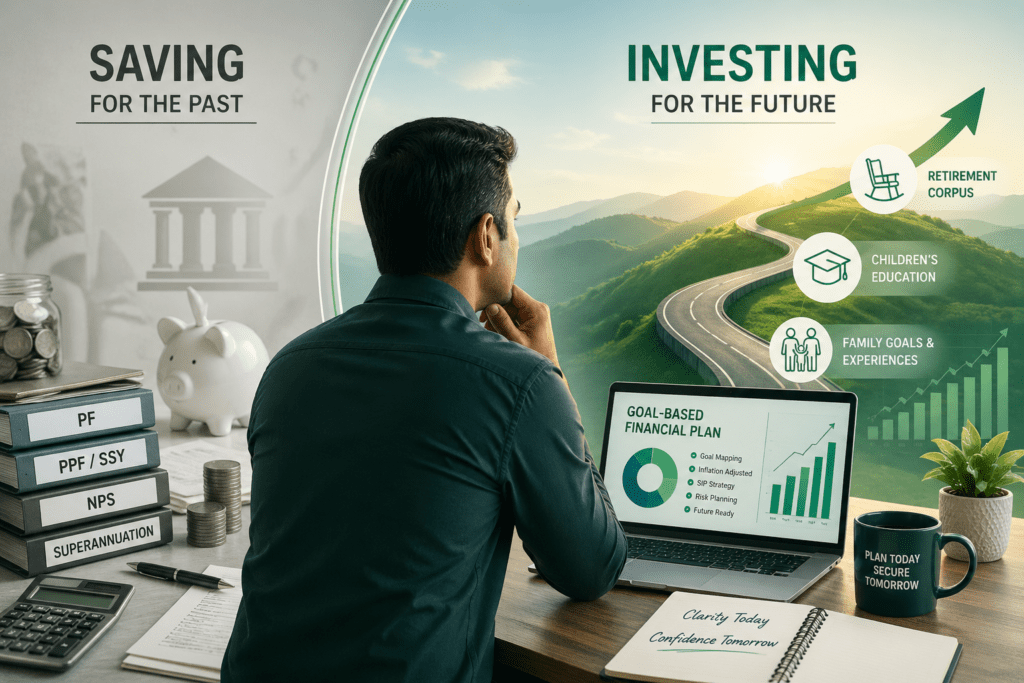
A Real Story That Might Change How You Look at Your Money
A client recently walked into our office with a concern that’s becoming increasingly common—
the growing retirement burden in India.
He had come across a statistic:
By 2050, 1 in every 5 Indians will be a senior citizen.
With limited social security support, the responsibility of building a secure future rests entirely on individuals.
And like many others, he believed he was doing everything right.
The “Safe” Portfolio That Wasn’t So Safe
On paper, his financial life looked well-organized.
He had invested in:
- Sukanya Samriddhi Yojana (SSY)
- Provident Fund (PF)
- National Pension System (NPS)
- A Superannuation Plan
He was disciplined, consistent, and committed to saving.
But when we looked deeper, a critical gap emerged:
He was product-rich, but goal-poor.
He had investments—but no clarity on:
- What each investment was meant to achieve
- Whether they would be sufficient for his future needs
- How his financial life would look 15–20 years from now
The Turning Point: Moving from Products to Purpose
We shifted the conversation from “Where are you investing?”
to “What are you investing for?”
Together, we mapped out his real-life goals:
- Children’s Education & Marriage
- Retirement Corpus
- Annual Vacations
- A special “Parents’ Vacation” fund
For the first time, his finances were aligned with his life.
The Reality Check: The Impact of Inflation
This is where things got interesting—and a bit uncomfortable.
We didn’t just look at today’s costs.
We projected the future value of each goal.
- General inflation: ~6%
- Education inflation in India: ~8–10%
A degree costing ₹20 lakh today could cost ₹50 lakh or more in the future.
This gap between perception and reality is where most financial plans fail.
Bridging the Gap: From Saving to Strategic Investing
Once we identified the gap, the path forward became clear.
We transitioned his approach from:
Random Saving → Goal-Based Investing
What changed?
- Introduced goal-linked SIPs (Systematic Investment Plans)
- Balanced his portfolio with growth-oriented investments
- Retained stability through existing fixed-income instruments
- Created a timeline-based investment roadmap
Planning for the Worst, Preparing for the Best
A crucial part of the process was stress-testing the plan.
We built scenarios where:
- Markets underperform
- Inflation rises further
- Life goals shift
The idea was simple:
If the plan works in tough conditions, it will thrive in normal ones.
The Outcome: Clarity Over Confusion
The transformation wasn’t just financial—it was emotional.
Before:
- Uncertainty
- Assumptions
- Silent anxiety
After:
- Clear goals
- Defined investment strategy
- Confidence in the future
He is no longer just “saving money.”
He is funding his future life with purpose.
The Bigger Lesson
Many individuals in India today are:
- Disciplined savers
- Consistent investors
But without a structured plan, even the best intentions can fall short.
Because ultimately:
It’s not about how many products you own—
it’s about whether they can fund your life goals.
Are You on Track?
Take a moment to reflect:
- Do you know the future cost of your goals?
- Are your current investments aligned with them?
- Have you accounted for inflation realistically?
If not, it might be time to move from saving by habit to investing with purpose.
Frequently Asked Questions
Everything you need to know about goal-based financial planning in India.
Q1. What is goal-based financial planning?
Goal-based financial planning links every investment you make to a specific life goal — such as children’s education, marriage, retirement, or vacations — rather than simply accumulating products. It ensures your money has a clear purpose and a measurable target.
Q2. How is goal-based investing different from regular saving?
Regular saving focuses on putting money aside without a clear plan. Goal-based investing maps each rupee to a future need, accounts for inflation, sets a timeline, and chooses the right instruments to bridge the gap between what you have today and what you’ll need tomorrow.
Q3. Why should I account for inflation in my financial plan?
Inflation erodes the purchasing power of money over time. A degree costing ₹20 lakh today could cost ₹50 lakh or more in 15–20 years due to education inflation of 8–10% per year. Ignoring inflation is one of the most common reasons financial plans fall short.
Q4. What is a goal-linked SIP and how does it work?
A goal-linked SIP (Systematic Investment Plan) is a monthly mutual fund investment specifically sized and timed to meet a defined goal. Instead of investing a random amount, you calculate the SIP needed to reach the future cost of each goal — whether it’s retirement, education, or travel — and invest accordingly.
Q5. Are PF, NPS, and SSY enough for long-term goals?
These instruments provide stability and tax benefits, but may not deliver the growth needed to beat inflation over the long term. A balanced portfolio combining fixed-income instruments with growth-oriented investments like equity mutual funds is typically more effective for achieving long-term life goals.
Q6. How do I know if my investments are aligned with my goals?
Ask yourself three questions: Do I know the future cost of each goal? Is each investment mapped to a specific goal? Have I accounted for realistic inflation? If the answer to any of these is “no,” a goal-based financial review would be a good starting point.
Q7. What if markets underperform or my goals change over time?
A well-structured financial plan includes stress-testing for scenarios where markets underperform or inflation rises. It also builds in flexibility so goals and contributions can be adjusted as life circumstances change. The key is having a dynamic plan, not a static one.
Q8. When should I start goal-based financial planning?
The earlier, the better — starting early gives your investments more time to grow and reduces the SIP amount needed to reach each goal. However, it’s never too late. Even if you’re in your 40s or 50s, restructuring your portfolio around clear goals can significantly improve your financial outcomes.
⚠️ Disclaimer
Mutual fund investments are subject to market risks. Read all scheme related documents carefully before investing. Past performance is not indicative of future results.