
Signal Over Noise: Is India Entering a New Private Investment Cycle?
June 30, 2026 · admin · Blog
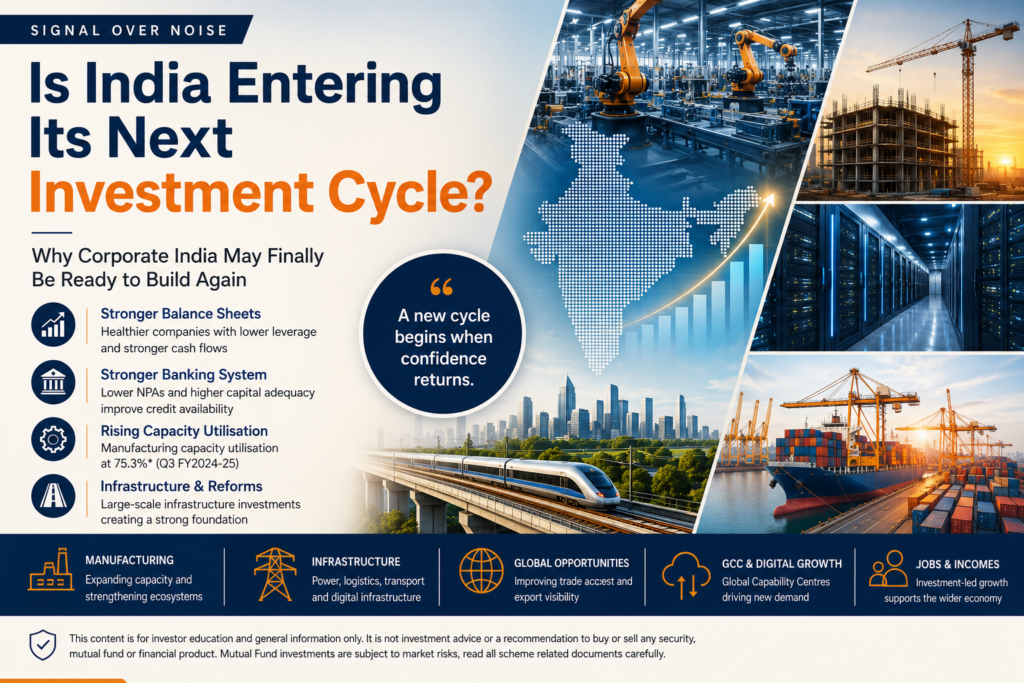
An educational perspective on one of the most discussed themes in the Indian economy today.
India’s economic growth story is often associated with consumption, demographics, digital adoption, and infrastructure development. However, another important trend is increasingly drawing attention from economists, policymakers, and market observers—the possibility of a new private sector capital expenditure (capex) cycle.
While public investment has remained a key growth driver in recent years, several indicators suggest that private sector participation may gradually increase over the coming years.
The question is not whether a capex cycle is guaranteed to emerge, but whether the conditions supporting one are becoming more visible.
What Is a Private Capex Cycle?
A private capex cycle refers to a period during which businesses increase investments in:
- Manufacturing facilities
- Production capacity
- Technology and automation
- Warehousing and logistics
- Power and energy infrastructure
- Equipment and machinery
These investments are generally undertaken when companies anticipate future demand growth and believe expanding capacity is economically viable.
Historically, strong capex cycles have played a significant role in supporting economic growth, employment generation, productivity improvements, and infrastructure development.
Why Is This Theme Receiving Attention?
Several economic developments have contributed to renewed discussions around private investment activity.
1. Capacity Utilisation Levels
According to data published by the Reserve Bank of India (RBI), capacity utilisation across several manufacturing industries has remained relatively healthy in recent periods.
When existing facilities operate at higher utilisation levels, businesses may begin evaluating the need for additional investments to support future growth.
2. Corporate Balance Sheets Have Strengthened
Many Indian companies have spent the past decade reducing debt, improving operational efficiency, and strengthening cash flows.
Healthier balance sheets can improve the ability of businesses to fund future expansion plans when opportunities arise.
3. Manufacturing Policy Support
Initiatives aimed at strengthening domestic manufacturing have encouraged investments across multiple industries.
Examples include:
- Production Linked Incentive (PLI) initiatives
- Supply chain diversification efforts
- Domestic manufacturing expansion programs
- Infrastructure development initiatives
Such measures may contribute to a more supportive environment for long-term industrial investments.
4. Infrastructure Development
Large-scale investments in roads, railways, logistics, ports, and digital infrastructure can create an ecosystem that supports private sector expansion.
Historically, improvements in infrastructure have often reduced operating costs and improved business efficiency.
Areas of the Economy That Could Experience Higher Activity
Past investment cycles have often coincided with increased economic activity in areas such as:
- Engineering and project execution
- Industrial manufacturing
- Capital equipment production
- Power infrastructure
- Logistics and transportation
- Warehousing and supply chain services
These observations are educational in nature and should not be interpreted as investment recommendations regarding any sector, company, mutual fund category, or investment strategy.
What Indicators Are Economists Monitoring?
Observers seeking to understand the evolution of a potential investment cycle often monitor several economic indicators:
Manufacturing Capacity Utilisation
Higher utilisation levels may indicate growing demand for additional production capacity.
Private Sector Investment Announcements
Corporate expansion plans and project announcements can provide insight into future investment intentions.
Credit Growth Trends
Business borrowing activity is often monitored as an indicator of investment demand.
Industrial Production Data
Industrial output trends may offer clues regarding manufacturing activity and capacity expansion.
Infrastructure Progress
Execution of large infrastructure projects can influence business investment decisions over time.
Frequently Asked Questions (FAQ)
What is capital expenditure (capex)?
Capital expenditure refers to funds invested by businesses in long-term assets such as factories, equipment, technology systems, infrastructure, or facilities that support future operations.
Why is private sector investment important?
Private investment can contribute to:
- Capacity expansion
- Job creation
- Productivity improvements
- Technological advancement
- Economic growth
The actual impact depends on broader economic conditions and project execution.
Does a capex cycle guarantee economic growth?
No.
While investment activity may support economic growth, outcomes depend on multiple factors including demand conditions, financing availability, policy stability, and global economic developments.
Which industries benefit first during a capex cycle?
Historically, increased investment activity has often coincided with higher economic activity across engineering, capital goods, logistics, power infrastructure, and related industries.
This observation is educational in nature and should not be interpreted as a recommendation regarding any security, sector, fund category, or investment strategy.
Does this mean investors should invest in infrastructure or capital goods funds?
No.
An economic trend and an investment decision are not the same. Investment decisions should consider factors such as financial goals, risk appetite, time horizon, diversification needs, and overall portfolio suitability.
Can a capex cycle take years to develop?
Yes.
Large investment cycles often evolve gradually over several years as businesses assess demand conditions, financing costs, regulatory developments, and project viability.
What risks could affect a potential capex cycle?
Several factors may influence future investment activity, including:
- Global economic conditions
- Interest rate movements
- Commodity price volatility
- Geopolitical developments
- Demand fluctuations
- Regulatory and policy changes
The Bigger Picture
India’s economic landscape continues to evolve through a combination of demographic advantages, infrastructure development, technological adoption, and manufacturing initiatives.
Whether a broad-based private investment cycle fully materialises remains uncertain. However, the indicators currently being discussed by economists and policymakers suggest that the theme warrants observation.
For investors and market participants, understanding these economic developments can provide useful context for interpreting broader economic trends. At the same time, investment decisions should always be aligned with individual financial objectives, risk tolerance, and long-term planning considerations.
Disclosure
Aksha Moneyworks4u Pvt. Ltd. is an AMFI-registered Mutual Fund Distributor (ARN-287729). We are not registered with SEBI as an Investment Adviser or Research Analyst. The information contained herein is intended solely for investor education and general awareness.
Disclaimer
Mutual Fund investments are subject to market risks. Read all scheme-related documents carefully before investing.
The information contained in this article is for educational and informational purposes only and should not be construed as investment advice, research, a recommendation, or a solicitation to buy or sell any security, mutual fund, or financial product. Views expressed are based on publicly available information believed to be reliable as of the date of publication and are subject to change without notice. Past trends may not continue in the future, and no assurance can be given regarding future economic outcomes or market developments. Investors should consult appropriate financial, tax, and legal professionals before making any investment decisions.